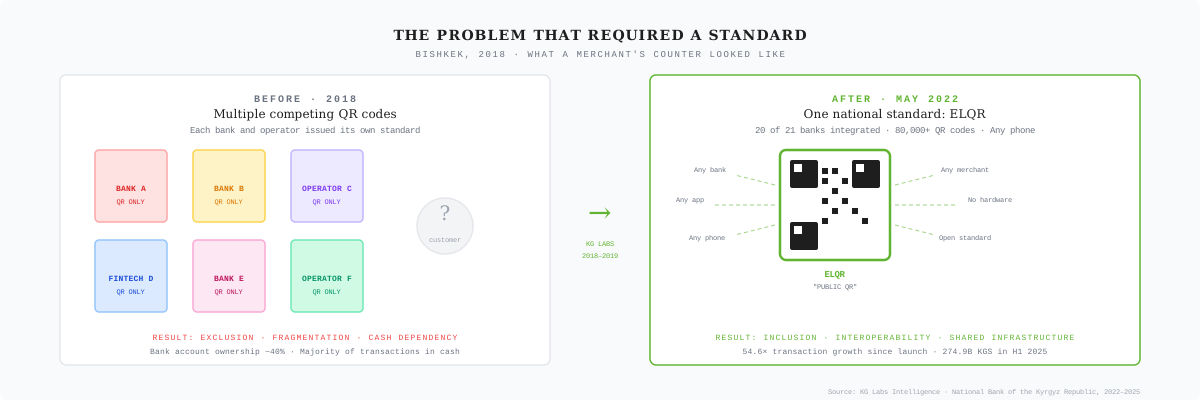
In September 2018, KG Labs organized the first in a four-part series of fintech events at ololohaus on Erkindik Avenue in Bishkek. Nobody in that room used the phrase «digital public good.» Nobody described what we were trying to build as «digital public infrastructure.» The language did not exist yet — not in Kyrgyzstan, and barely anywhere else. What we were talking about was simpler and more concrete: how to make cashless payments work for everyone, not just for customers of whichever bank happened to have signed the most merchants.
The problem in 2018 was visible in any coffee shop or market stall in Bishkek. Walk in to pay, and you would find four, five, sometimes six different QR codes on the counter — each belonging to a different fintech or bank, each usable only by that institution’s customers. The technology existed. The ecosystem was fragmented. And every player had a rational incentive to keep it that way: the first to lock in enough merchants would gain a structural advantage. Bank account ownership in the country was around 40%. Digital payments were not distant — they were splintered.
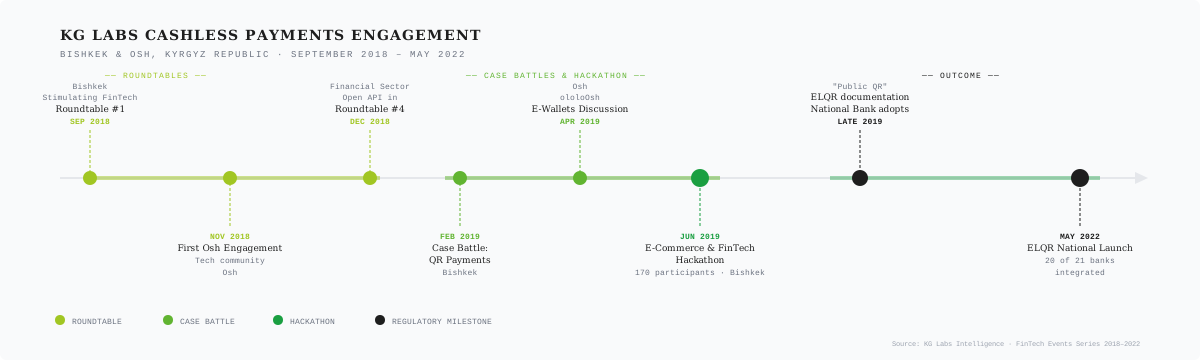
KG Labs ran four roundtable events across autumn 2018 — September through December — each at ololohaus on Erkindik Avenue in Bishkek, each bringing a different cross-section of stakeholders into the same room: the National Payment System ElCart, the Interbank Processing Center, mobile operators, fintechs, regulators. Each examined a different dimension of the problem — stimulating fintech adoption, the mechanics of cashless systems, e-commerce integration, open APIs in the financial sector.
The series did not stay in Bishkek. In November 2018, KG Labs met with the tech community in Osh, Kyrgyzstan’s second city. In April 2019, a dedicated discussion on electronic wallets was organized at ololoOsh — the same format, different geography, different participants. The expansion mattered: cashless payments that work only in the capital are not cashless payments for the country.
Alongside the roundtables, KG Labs ran case battles — a structured competitive format where teams worked through real payment infrastructure problems and produced recommendations that went directly to regulators. The February 2019 Case Battle on QR payments was the most focused: teams made the technical and policy case for a unified standard, in front of the stakeholders who would eventually have to decide.

Throughout this period, the reference point we kept introducing was China — not as a model to replicate, but as evidence that interoperability between competing platforms was achievable. Alipay and WeChat Pay had been made to work together across any smartphone camera, any merchant, without proprietary hardware. The argument for Kyrgyzstan was not ideological. It was practical: a fragmented standard benefits the strongest player and excludes everyone else. A shared standard is infrastructure.
The National Bank was cautious. That is not a criticism — payment system regulators move carefully, and there was no domestic precedent for what we were proposing. The conversations across 2018 and into 2019 resolved nothing immediately. What they did was establish a shared frame: that the question of standards was a public interest question, not only a commercial one.
The culminating event of this entire engagement arc was the E-Commerce and FinTech Hackathon in June 2019 — 170 participants, ten teams, three days of prototype development and mentorship organized jointly with the National Payment System ElCart and the Interbank Processing Center. The winning project, AgroSale, was an agricultural marketplace. But the hackathon itself demonstrated something beyond any single product: that a broad community — technical, commercial, civic — had formed around the question of open digital infrastructure, and was ready to build within it.
By late 2019, the National Bank adopted foundational documentation for a unified national QR standard. They called it ELQR — «Public QR.» The word *public* was not accidental.
What followed — COVID accelerating the transition, full national piloting in 2021, the formal launch in May 2022 — is documented elsewhere. The outcome, measured in transaction volumes and financial inclusion numbers, is significant. But the period from 2018 to 2022 is the part that rarely gets described: the years when the work had no name, when the case had to be made repeatedly and differently to different audiences, when the result was not yet visible.
This is the type of engagement KG Labs pursues across technology-driven topics — bringing stakeholders into the same room before consensus exists, making the case for open standards and shared infrastructure, and staying in that process long enough for institutions to move. The vocabulary changes: what was called cashless payments in 2018 is now called a digital public good. The underlying question remains the same — who benefits from the way a technology is deployed, and who decides.
—
*This piece covers KG Labs’ advocacy role from 2018 to the ELQR launch in 2022. For the full account of the transformation and its outcomes, see: [How Kyrgyzstan in Just Three Years Transformed to a Cashless Economy](https://kglabs.org/how-kyrgyzstan-in-just-three-years-transformed-to-cashless-economy-by-integrating-qr-as-digital-public-good/)*
—
*Data in this piece draws on KG Labs Intelligence, including National Bank of the Kyrgyz Republic transaction reporting and the KG Labs FinTech research and events series, 2018–2019.*
