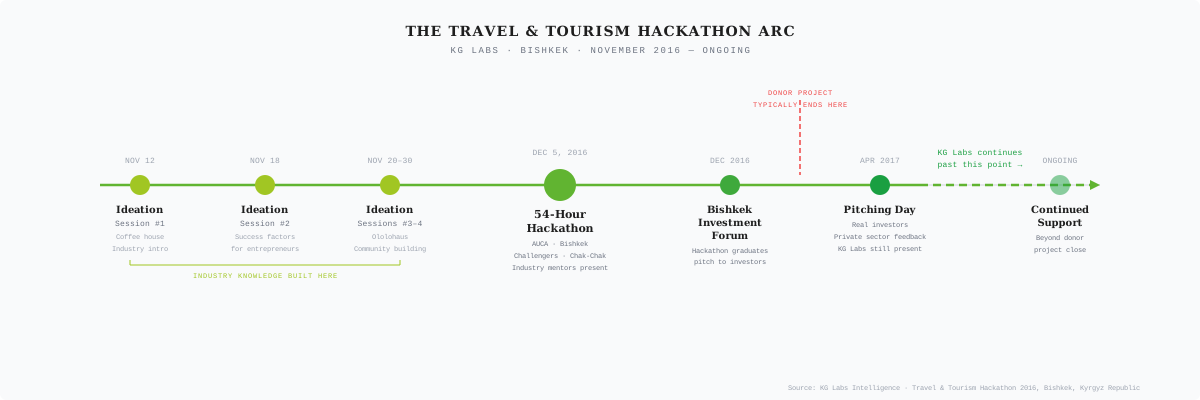
In November 2016, before KG Labs ran its Travel & Tourism Hackathon, we ran four sessions. Panel discussions with industry professionals. Open meetups at coffee houses and at Ololohaus in Bishkek. Each one built on the last — introducing the tourism sector’s actual problems, connecting people who were thinking about the same questions, giving potential participants a vocabulary and a community before they ever sat down to build anything.
The logic was simple: a 54-hour hackathon rewards preparation. Participants who arrive with domain knowledge, with relationships, and with a rough sense of the problem space produce better ideas than those arriving cold. The ideation sessions were not a warm-up act. They were the foundational layer without which the hackathon itself would have been thinner.
The December event at the American University in Central Asia confirmed this. Teams came in with real industry context — and it showed in what they built. The winning team, «Challengers,» designed a gamified cultural immersion platform: tourists earning their way through yurt assembly, kumys preparation, traditional cooking, each activity unlocking partner discounts and deeper access to the culture. The runners-up, «Chak-Chak,» built a Telegram chatbot providing real-time intercity transport prices and a basic Kyrgyz-English phrasebook. Both teams left with investor interest. The April 2017 Pitching Day was a natural continuation of the same arc — KG Labs continuing to support the teams from the December cohort, connecting them to real investors and private sector feedback, working toward the point where these projects could grow organically and integrate into the economy. The ideation sessions, the hackathon, and the months of support that followed were one continuous sequence — not a program with a closing ceremony, but an ongoing engagement with the people and ideas that had come through it. The ideas were grounded because the people who built them had spent a month in conversation with the industry before they wrote a line of code or drew a diagram.
In the years that followed, hackathons became a popular format across Kyrgyzstan and the wider Central Asian region. Donors found them investable: visible, time-bounded, photogenic, easily reported. An event with a clear start date and end date and three award ceremonies is a comfortable fit for project cycles and communications budgets. The format spread.
What did not spread, in most cases, was the methodology underneath it.
The ideation sessions — the panel discussions, the meetups with people who actually worked in the industry — were typically absent. The result was predictable: participants arrived at hackathons without the conceptual scaffolding to build solutions that connected to real problems. The quality of ideas was lower. The gap between what teams proposed and what the industry actually needed was wider. Projects were more likely to be technically interesting and practically disconnected.
The second missing component was the role of industry professionals during the event itself. In donor-driven hackathons, practitioners are typically visible in one role: as judges at the final pitch. They arrive at the end, evaluate what has been built, and award prizes. What they are not is present throughout — as mentors, as people who can redirect a team that is solving the wrong problem, as sources of honest feedback about whether a solution maps to a real pain or an imagined one. That distinction matters enormously to the quality of what a hackathon produces.
The deeper problem is structural. A hackathon, as a donor program component, tends to be optimized around the event itself rather than around what the event is supposed to produce. The three winners get prizes. The project report is filed. When the program ends, the projects that emerged from it largely end with it — not because the ideas were bad, but because the institutional support, the industry connections, and the follow-through infrastructure were never built in. The hackathon was the deliverable. Anything lasting would have required a different kind of commitment.
KG Labs has operated from a different premise: that an innovation event is only as good as the ecosystem it builds into. The ideation sessions before a hackathon are not a nicety — they are how participants arrive knowing enough to be useful. The industry mentors present throughout an event are not optional — they are the feedback mechanism that separates a prototype worth pursuing from one that was never going to work. And the support that follows — connecting teams to investors, providing feedback from real private sector actors, staying engaged as projects move from prototype toward something viable — is not a bonus; it is where the work either becomes real or evaporates. Critically, that support does not end when the donor project closes. The projects that come out of a well-run hackathon need time to grow, and that timeline rarely fits a project cycle. KG Labs’ engagement with the teams that came through the Travel & Tourism Hackathon outlasted the program that funded the event. That is the point: the goal was never to run a hackathon. It was to help ideas integrate into the economy.
This approach takes more time and more organizational investment than a standalone event. It is harder to fund because the value is harder to photograph. But the alternative — a well-attended, well-documented hackathon that produces nothing lasting — is a cost that falls on the participants, not the funders. The teams that spent a weekend building something they believed in, and then watched it go nowhere when the project closed, bear that cost quietly.
—
The observation is not specific to Kyrgyzstan, though that is where KG Labs has done this work directly. Across Central Asia, the same pattern recurs: hackathon formats imported with enthusiasm, ideation and industry engagement left behind as too expensive or too slow. The format is popular precisely because it compresses complex ecosystem-building work into a reportable event. But the compression is where the value goes missing.
What makes a hackathon worth running is the infrastructure around it — the conversations that happen before it, the practitioners who remain engaged during it, and the institutional patience to support what emerges after it. The 54 hours in the middle are not the point.
*The KG Labs Travel & Tourism Hackathon 2016 was organized in partnership with the American University in Central Asia and Ideagrad, with support from the U.S. Embassy Democratic Commission, USAID Business Development Initiative, and the Tourism Department of the Kyrgyz Republic.*
