In late October 2018, the results of a British Council funding round were announced for the Creative Spark Higher Education Enterprise Programme — a five-year initiative linking universities in seven countries (Kazakhstan, Uzbekistan, Kyrgyzstan, Azerbaijan, Armenia, Georgia, and Ukraine) to UK institutions, with the stated goal of building creative entrepreneurship capacity among students and young entrepreneurs. Kyrgyzstan received three grants in total. One of them went to a partnership of the AUCA Centre for Additional Education, Enactus Kyrgyzstan, and KG Labs Public Foundation, with Cass Business School (City, University of London) and Change School as UK counterparts. What followed over the next eight months was one of the more methodologically interesting creative education experiments to run in Bishkek in recent years — not because of the prize money, of which there was none, but because of how the sequence worked.
The Structure: What “Creative Spark” Actually Asked Participants to Do
The British Council’s programme design was a cascade. The implementing partners — in this case Natalia Slastnikova’s team at the AUCA Centre for Additional Education, with Enactus Kyrgyzstan coordinating the university networks — first had to produce trainers, and only then could those trainers produce participants. Before any student or young entrepreneur saw the inside of a workshop, a week-long train-the-trainer event brought teachers and Enactus business advisors from ten Bishkek universities together with two UK practitioners: Sarah Jones from Cass Business School, City University of London, and Neil Marshall from Change School. The methodology was design thinking and the Business Model Canvas — practical tools for moving from problem identification to business idea generation to pitch. The stated rule of the training was “I do and I understand”: no pre-packaged answers, only process that the groups worked through on actual problems they had defined themselves.
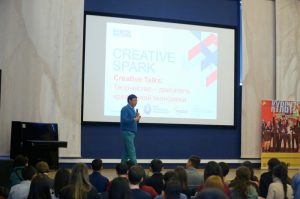
Before that even started, a series of awareness events called Creative Talks ran across ten Bishkek universities in open format — free, no enrolment required, anyone aged 18 to 35 welcome. The talks were introductory: what the creative economy was, what the project offered, what the competition at the end looked like. Aziz Soltobaev presented on the trajectory of creative economy development at the opening event. More than 700 people came through those sessions across the university circuit. The numbers the programme needed for the training phase came mostly from that outreach.
The Training Phase: 500 Participants, Ten Universities, One Methodology
The trained Enactus advisors and teachers then ran the workshop series on their own campuses: problem-finding, idea generation, iterative testing, pitch construction. The beneficiary count reached more than 500 across the university network — a mix of Enactus team members, other enrolled students, and young entrepreneurs who had come in through the open Creative Talks. The quality of the methodology is worth noting: design thinking workshops in a Bishkek university setting in 2019, delivered not by external consultants but by the Enactus advisors who had gone through the UK-led train-the-trainer the month before, was a structural choice with consequences. The trainers were already embedded in the institutions. They had advisees they would see again. The learning did not stop when the UK experts flew home.
Big Idea Challenge: Ten Teams, One Stage, June 2019
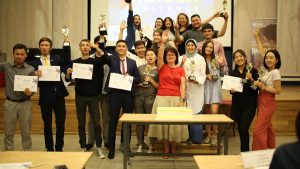
At the end of the training and pre-pitch competition cycle at each university, ten finalist teams emerged. On June 4, 2019, the AUCA campus hosted the awards ceremony for those ten teams: more than a hundred project beneficiaries in the audience, each team presenting a one-minute pitch from the stage. The format was deliberately compact — enough to give every team a public moment, short enough that the audience could hold ten ideas in sequence. Each finalist received a trophy and a certificate. The evening ended with a cake labelled “The Big Idea Challenge,” which is either a piece of event design or an editorial choice, depending on how you read it.
The ten finalists then entered the national competition stage, where three projects advanced: Safe Watch, a tracker with satellite signal and SOS button; Smartech, a vending machine production and service operation for the Kyrgyz market; and Oinobook, a felt book designed to introduce children to Kyrgyz national traditions through tactile play. At the international stage in Tashkent, Oinobook — developed by Aizada Tynybekova and her team — won both the “Most Creative Project” nomination among Kyrgyzstan’s three finalists and the overall country championship in the Big Idea Challenge. Smartech, represented by Abdul-Hakim Bakriev, was recognised as the best national technology project. Aizada Tynybekova went on to London to compete against the six other country champions from Kazakhstan, Uzbekistan, Azerbaijan, Armenia, Georgia, and Ukraine.
What the Numbers Looked Like
| Stage | Activity | Scale | Period |
|---|---|---|---|
| Awareness | Creative Talks: 10 Bishkek universities, open format | 700+ participants | Nov 2018 – Jan 2019 |
| Trainer preparation | UK train-the-trainer: design thinking + Canvas (Sarah Jones, Neil Marshall) | 10 universities’ Enactus advisors | Early 2019 |
| Training rollout | Workshop series at 10 universities | 500+ beneficiaries | Feb – May 2019 |
| Pre-pitch competitions | University-level selection rounds | 10 universities | May – Jun 2019 |
| Partnership finals | Big Idea Challenge ceremony, AUCA | 10 finalist teams; 100+ attendees | June 4, 2019 |
| National competition | Country-level selection | 3 finalists: Safe Watch, Smartech, Oinobook | Jun–Jul 2019 |
| International stage | Big Idea Challenge, Tashkent | Oinobook: Kyrgyzstan champion; London qualification | Jul 2019 |
Three Observations on the Kyrgyz Context
The first is structural. A programme that had to produce results in eight months, across ten Bishkek universities, against a competition format, with trainers who had never run creative entrepreneurship workshops before — that is a demanding sequencing problem. The train-the-trainer model resolved part of it: instead of deploying consultants to each campus, the project built capacity inside the institutions themselves and let the advisors who already had relationships with their Enactus teams do the teaching. Whether that model holds in year two, when the novelty has worn off and the UK trainers are not present to re-energise the methodology, is the real test.
The second is about what the winning project was. Oinobook — a felt book that introduces Kyrgyz national traditions to children through tactile, story-based play — is not a technology startup, a fintech product, or a platform. It is a craft-and-content enterprise with an explicitly cultural mission. That it won the creative project nomination and the overall national championship in a British Council programme explicitly designed to develop the creative economy suggests something about what “creative entrepreneurship” looks like when it lands in a country with a strong traditional crafts identity and a tourism-facing export opportunity. The project’s design fits the Kyrgyz context in a way that a generic app concept would not have.
The third observation is one the programme itself seemed aware of, based on the post-script in the original summary: the project was renewed for year two before year one was over. That is not something that happens with programming that underperformed. Whatever the London competition result turned out to be, the 700-person Creative Talks audience, the 500 trained participants, and the ten teams who built projects that they continued working on after the ceremony — those numbers were already visible when the British Council made its decision to continue.
Programme Details
| Programme | Creative Spark: Higher Education Enterprise Programme |
| Funder / Coordinator | British Council (5-year initiative, 35 international partnerships) |
| Countries covered | Kazakhstan, Uzbekistan, Kyrgyzstan, Azerbaijan, Armenia, Georgia, Ukraine |
| Kyrgyz grants | 3 (this post covers the AUCA Centre for Additional Education partnership) |
| Year 1 delivery period | October 2018 – July 2019 |
| Kyrgyz implementing partners | AUCA Centre for Additional Education (lead, Natalia Slastnikova); Enactus Kyrgyzstan; KG Labs Public Foundation |
| UK partners | Cass Business School, City University of London (Sarah Jones); Change School (Neil Marshall) |
| Target group | University students and young entrepreneurs, 17–35 years |
| University network | 10 universities in Bishkek (Enactus teams) |
| Kyrgyzstan champion | Oinobook — Aizada Tynybekova (felt book developing Kyrgyz national traditions for children); advanced to London international competition |
| Best technology project (national) | Smartech — Abdul-Hakim Bakriev (vending machine production and service, Kyrgyzstan) |