
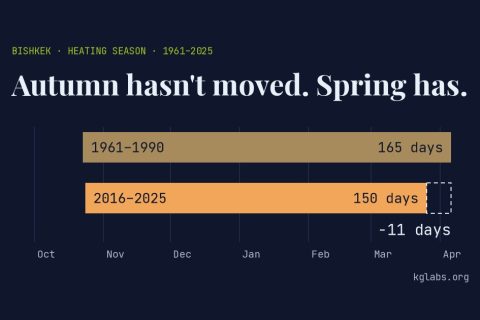
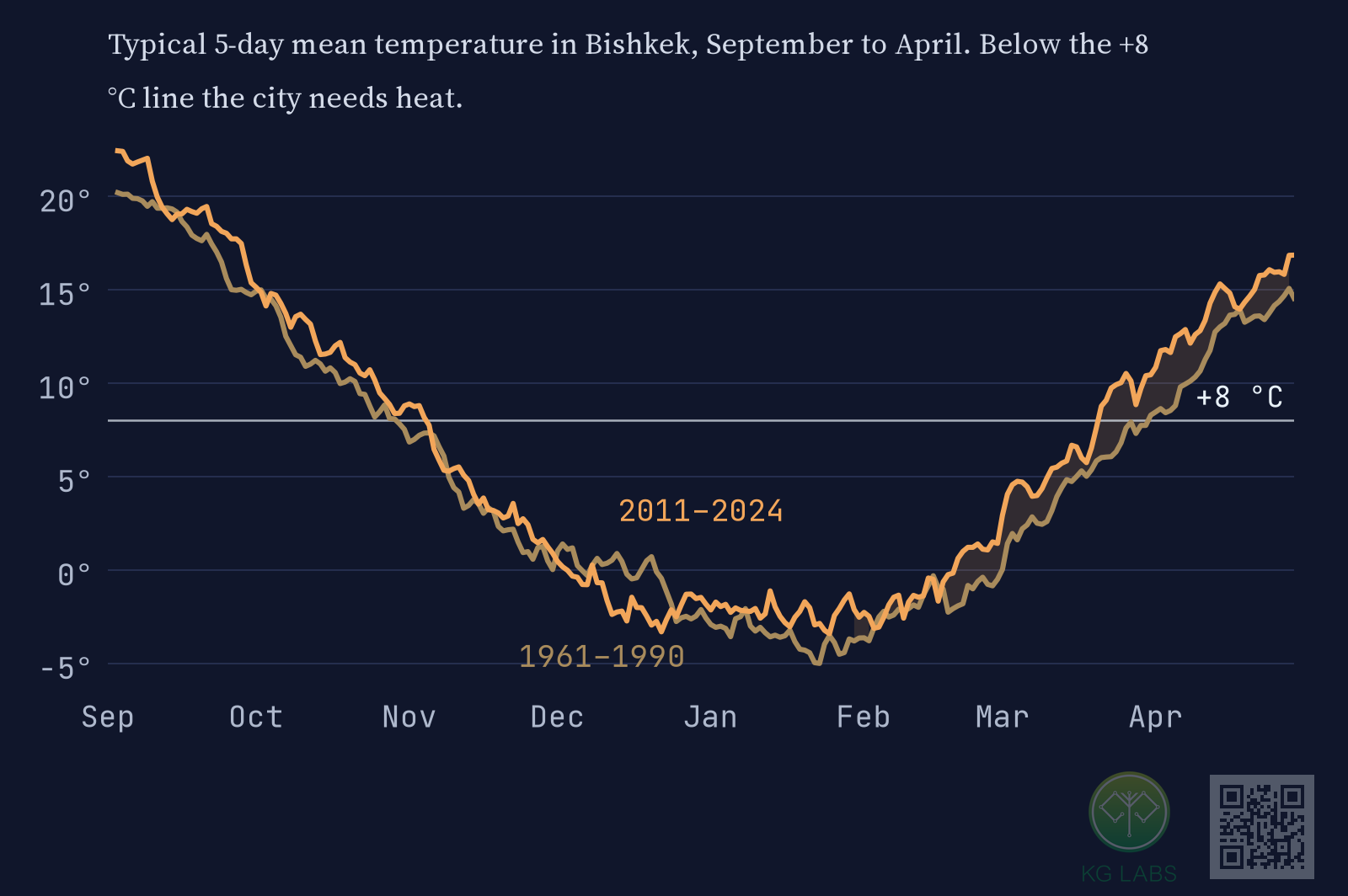
Short answer: Bishkek switches the heating on when the average temperature over five days falls to +8 °C, and off after five days in a row above +8 °C. From 2008 to 2025 Bishkek City Hall announced the start between 5 October and 10 November, most often around 27 October. In recent years the heating has gone off in mid- to late March.
When does the heating season start in Bishkek in 2026?
Bishkek City Hall announces the date each autumn, once the weather meets the +8 °C rule. Over the last thirty winters the rule was met most often around 27 October, and in eight winters out of ten between 12 October and 10 November. In a cold autumn the heating can come on in the first week of October, as it did on 5 October 2021.
When did the heating season start in previous years?
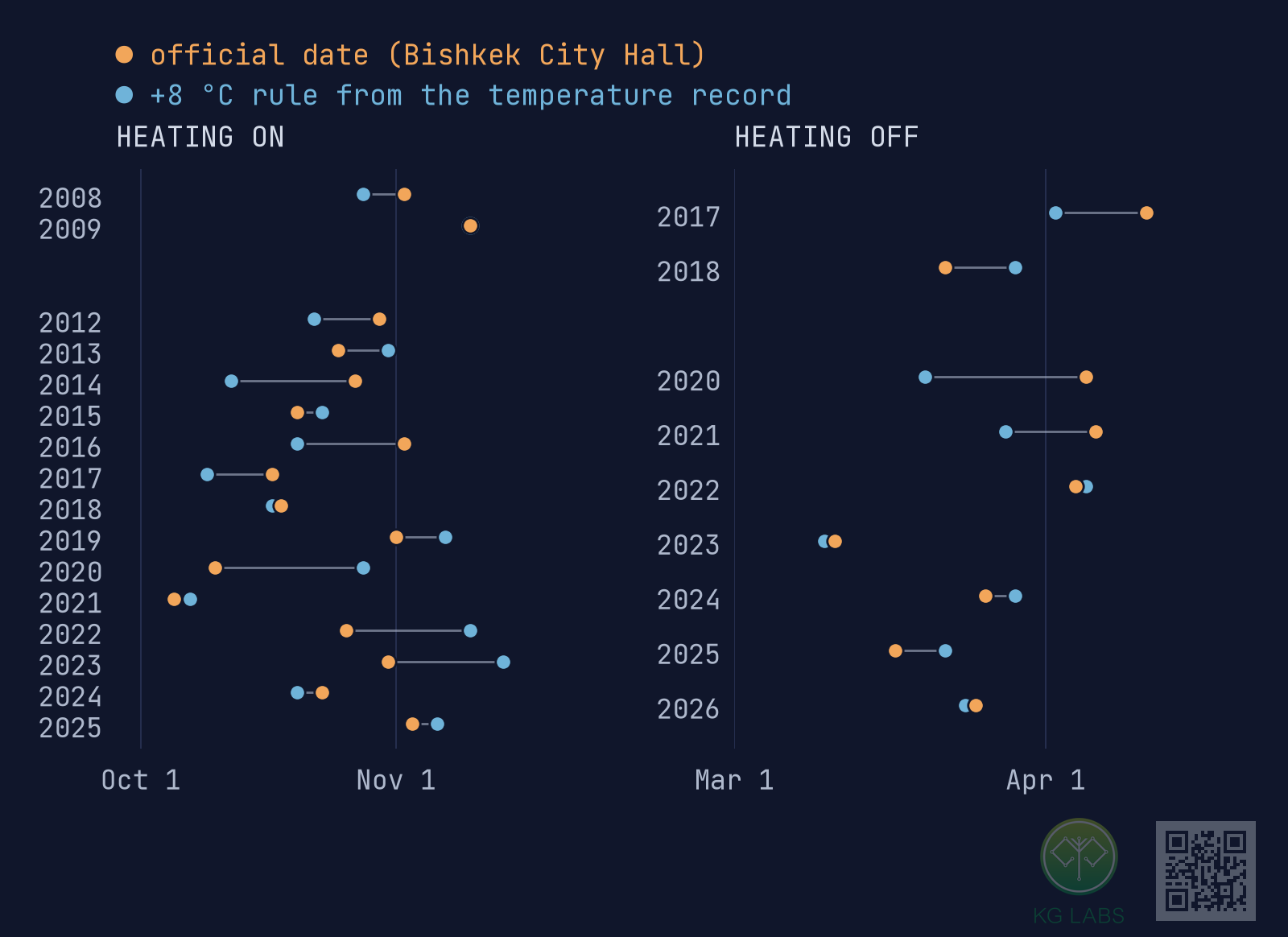
Official start and end dates since 2008, as announced by Bishkek City Hall and reported in the media:
| Winter | Heating on | Heating off |
|---|---|---|
| 2026/27 | to be announced | |
| 2025/26 | 3 November | 25 March |
| 2024/25 | 22 October | 17 March |
| 2023/24 | 31 October | 25 March |
| 2022/23 | 26 October | 11 March |
| 2021/22 | 5 October | 4 April |
| 2020/21 | 9 October | 6 April |
| 2019/20 | 1 November | 4 April (first off 19 March, back on 24 March) |
| 2018/19 | 18 October | late March (after 25 March) |
| 2017/18 | 17 October | 22 March |
| 2016/17 | 1 November | 11 April |
| 2015/16 | 20 October | — |
| 2014/15 | 27 October | — |
| 2013/14 | 25 October | — |
| 2012/13 | 29 October | — |
| 2011/12 | — | — |
| 2010/11 | — | — |
| 2009/10 | 10 November | — |
| 2008/09 | 1 November | — |
When is the heating switched off in Bishkek?
The heating goes off after five days in a row above +8 °C. From 2017 to 2026 that happened between 11 March (2023) and 11 April (2017); in spring 2026 it was 25 March. Sometimes a cold snap brings it back: in 2020 the heating was switched off on 19 March, back on 24 March, and off for good on 4 April.
Has the heating season changed since 1961?
The Bishkek combined heat and power plant began supplying heat on 14 September 1961. We applied the city’s +8 °C rule to every winter since, from 1961/62 to 2025/26. Each line below is one winter, from the day the rule says heating should come on to the day it could go off. Lighter lines are colder winters.
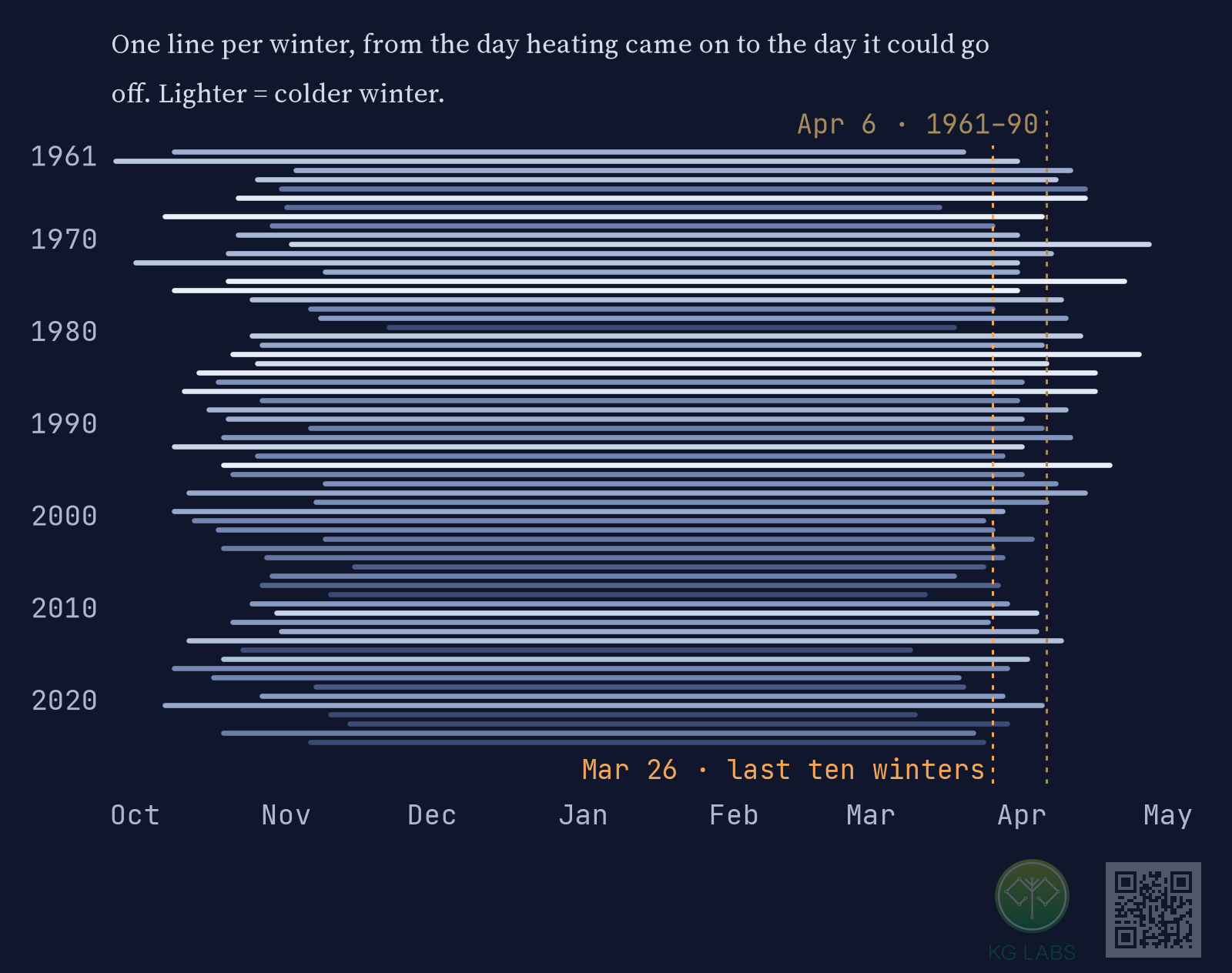
The start barely moves. In 1961–1990 the rule typically called for heat around 23 October; in the last ten winters, around 24 October. The end moves. In 1961–1990 the heating could typically go off around 6 April; in the last ten winters, around 26 March. That is about two days earlier per decade, a steady shift clear in the record.
How many days does the heating season last in Bishkek?
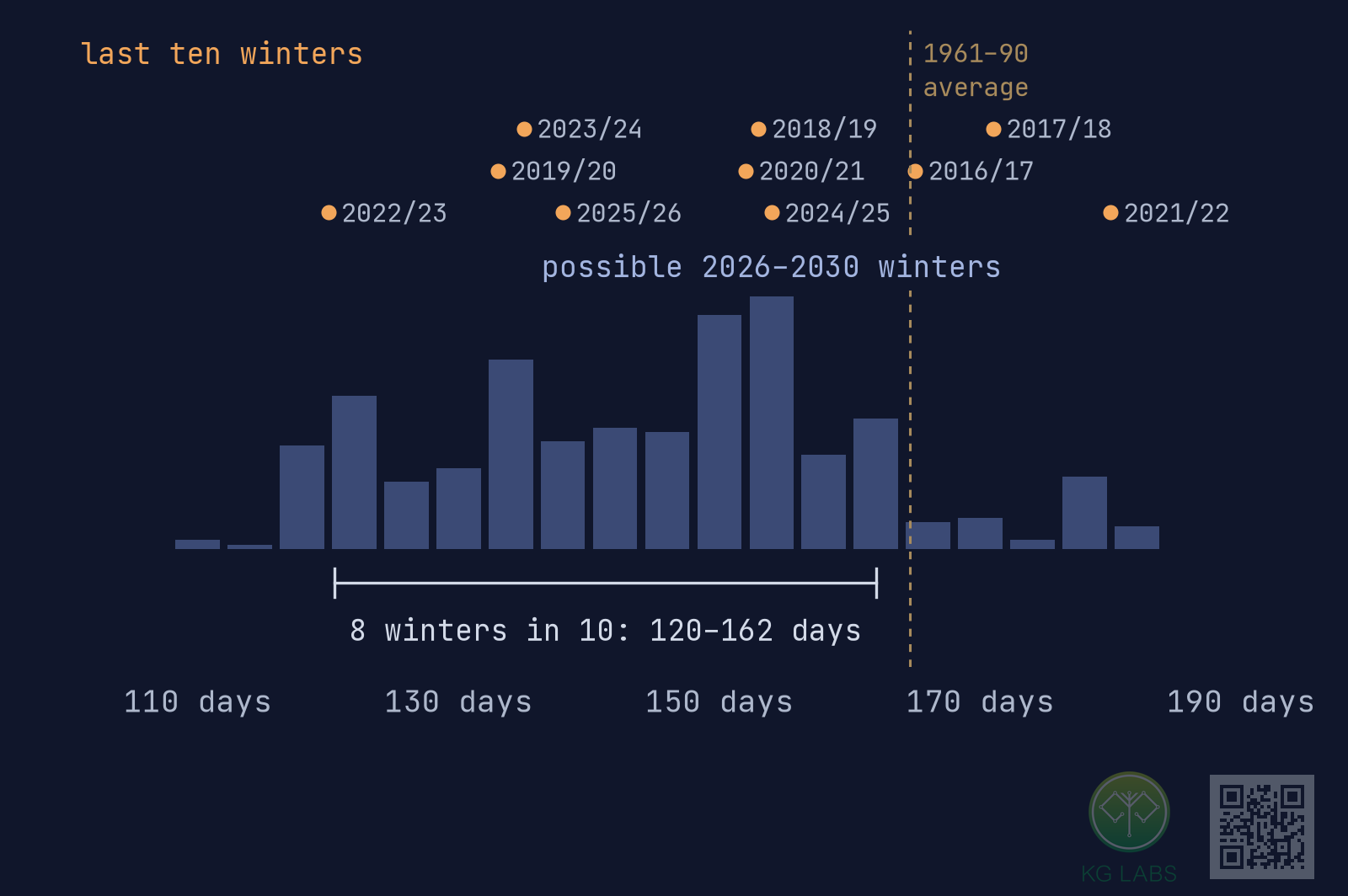
By the weather, a typical Bishkek winter now needs about 150 days of heating, down from about 165 in 1961–1990. Counting how cold those days are as well as how many, the heat the weather demands has fallen by about 13%. Single winters still vary widely: 1980/81 needed 116 days, 1987/88 needed 187, and among recent winters 2022/23 needed 120 and 2021/22 needed 180.
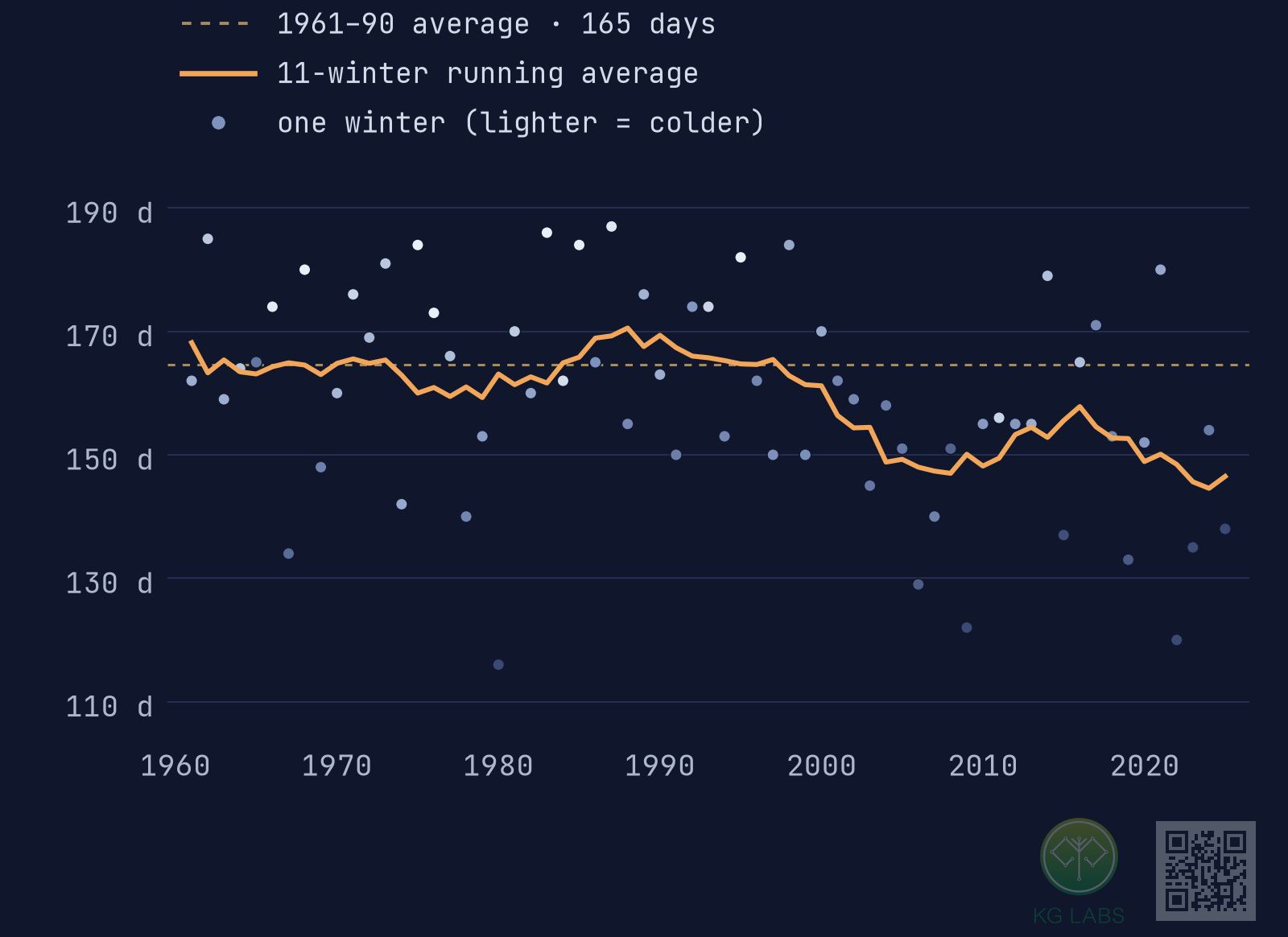
This is the weather side. How much fuel the city actually burns also depends on buildings, insulation and the heating network.
Do the official dates follow the weather?
Closely. We compared the rule with Bishkek City Hall’s dates: start dates 2008–2025 and end dates 2017–2026. On average they differ by about a week, 7.5 days in autumn and 6 in spring. In spring 2020 the rule points to 19 March, the day the heating was first switched off.
What will the heating season be like in 2026–2030?
We added the warming that 14 climate models (CMIP6, middle emissions path) project for 2026–2030 to the real daily weather of the past thirty winters and ran the rule again. The next five winters look much like recent ones: on average about three days shorter, with 11 of the 14 models leaning that way. Single winters will still range widely, from about 120 to 162 days for eight winters in ten. This is a range of possible winters, not a forecast of any one.
A climate record kept in every flat
Most climate records need instruments and archives. The heating season is one that every household in Bishkek keeps without trying: the week the radiators come on, the week they go cold. Across sixty-five winters it shows a city whose autumns still arrive on time and whose springs now come earlier. The same +8 °C rule, inherited from Soviet building norms, sets the heating calendar in cities across Central Asia. Whether their springs are moving the same way is a question the same method can answer.
Frequently asked questions
When does the heating season start in Bishkek?
When the 5-day mean temperature falls to +8 °C. Since 2008 Bishkek City Hall has announced the start between 5 October and 10 November, most often in the last ten days of October.
When was the heating switched on in Bishkek in 2025?
On 3 November 2025, according to Bishkek City Hall. It was switched off on 25 March 2026.
When is the heating switched off in Bishkek?
After five days in a row above +8 °C. In 2017–2026 that was between 11 March and 11 April, most often in the second half of March.
Who decides when the heating season starts?
Bishkek City Hall announces the dates, based on the temperature rule.
Is the heating season in Bishkek getting shorter?
Yes, by the weather: about 150 heating days a winter in the last ten winters against about 165 in 1961–1990, mostly because spring warms up earlier.
How we did it
- Temperature: ERA5-Land daily mean air temperature (ECMWF/Copernicus) at the point of Bishkek’s weather station, 1961–2026, corrected month by month to the station’s monthly record (NSIDC G02174, 1961–2003; monthly correlation 0.90).
- Rule: heating on the day after the 5-day running mean first falls to +8 °C or below after 1 August; off the day after the fifth consecutive day above +8 °C after 1 February.
- Trends (Theil–Sen, 1961–2025): season length −3.5 days per decade (95% range −5.4 to −1.2); spring end −2.3 days per decade; autumn start +0.7, not distinguishable from zero.
- The station warmed about 0.2 °C per decade faster than the grid cell in 1961–2003, so the shortening in the city is probably a little larger than shown.
- Official dates: Bishkek City Hall announcements as reported in the media, start dates 2008–2025 and end dates 2017–2026.
- 2026–2030: 14 CMIP6 models, SSP2-4.5, nearest grid cell; the monthly change between 2016–2025 and 2026–2030 added to daily weather of 1996–2025.
This story is part of KG Labs’ work with historical weather records, satellite data and climate models on how a changing climate reaches daily life in Kyrgyzstan, from mountain glaciers to your radiator.