
Sary-Chelek Lake sits above 2,000 metres in the Tian Shan foothills of western Kyrgyzstan, inside a biosphere reserve that ornithologists consider one of the most significant migratory bird stopover sites in Central Asia. Chatyr-Köl and Son-Köl, further east, sit above 3,000 metres and draw researchers for similar reasons — altitude, isolation, and an ecology that shifts visibly with the seasons.
Between October and April, all three are effectively unreachable. Snow closes the roads. The lakes continue doing what they do — birds pass through or don’t, water levels change, temperatures drop and rise — but no one is present to observe it. Monitoring stops not because the phenomena stop, but because the only monitoring method available requires a human being to be physically there.
This is not an edge case. It describes the condition of most high-altitude environmental monitoring in Kyrgyzstan: observation seasons defined by road access, not by scientific priority.
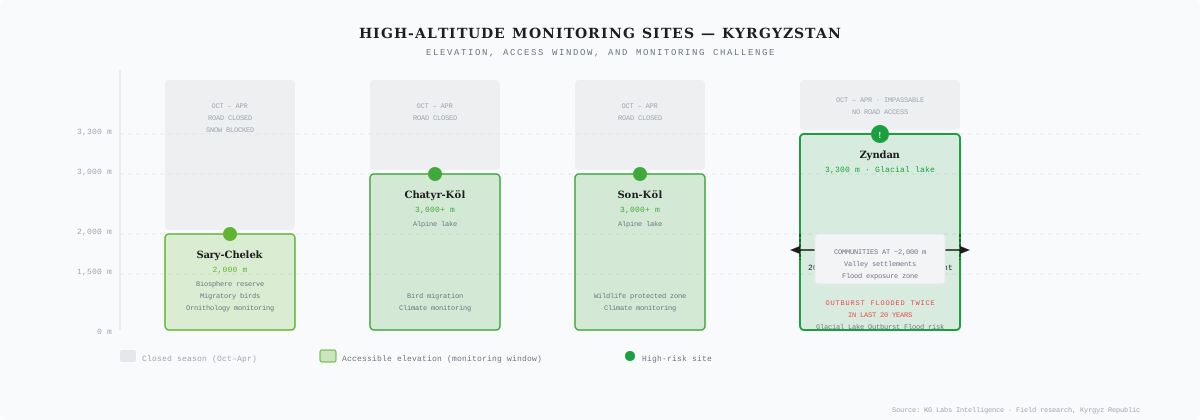
The ornithology problem has a specific shape. Researchers studying migratory patterns at Sary-Chelek can work across the accessible months and draw conclusions about that period. What occurs during the closed season — whether a species passes through earlier than recorded, whether a population anomaly is detectable, whether a pattern is shifting year on year — remains invisible. The scientific record has a six-month gap by default, every year.
KG Labs has been working on one thread of this problem directly: bird identification by sound. Acoustic monitoring — deploying microphones on edge devices that run freely available global AI audio classification models — makes it possible to detect and log species by their calls without a researcher present. The models exist. The hardware to run them locally is inexpensive and durable. The work is in adapting and improving the underlying bird sound datasets for Central Asian species distributions, which are underrepresented in global training data, and in calibrating deployments for the specific acoustic conditions of high-altitude lake environments. A device left at Sary-Chelek in September can continue recording, classifying, and logging through winter without any human intervention.
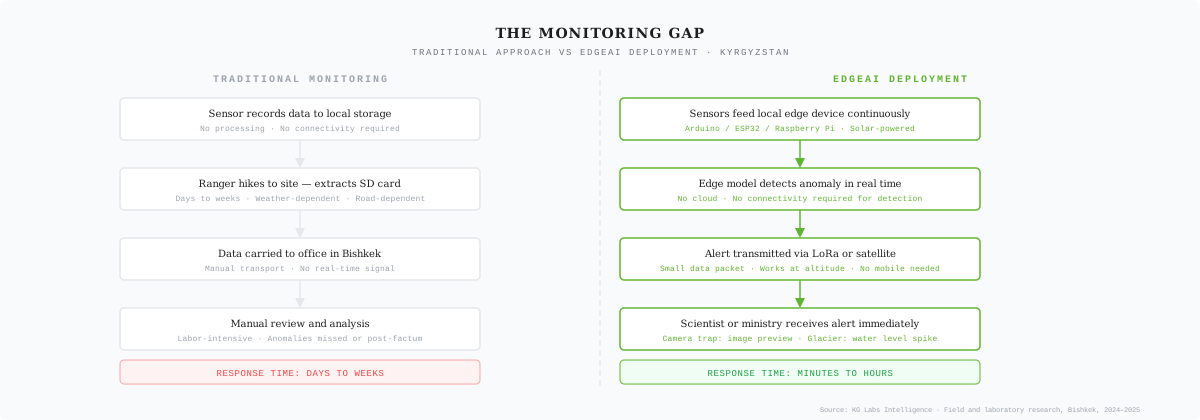
A related problem runs in parallel for wildlife rangers working in the same protected zones. Camera traps — motion-triggered devices used to document wildlife — are standard tools in Kyrgyzstan’s biosphere reserves. In practice, a ranger hikes into the field, retrieves an SD card, carries it back, and loads the footage manually for review. The cycle takes days or weeks. Much of the recorded footage is empty frames triggered by wind or light. The animals that matter — snow leopards, ibex, rare raptors — appear infrequently and may be missed in the volume of data, or identified only after the relevant moment has passed.
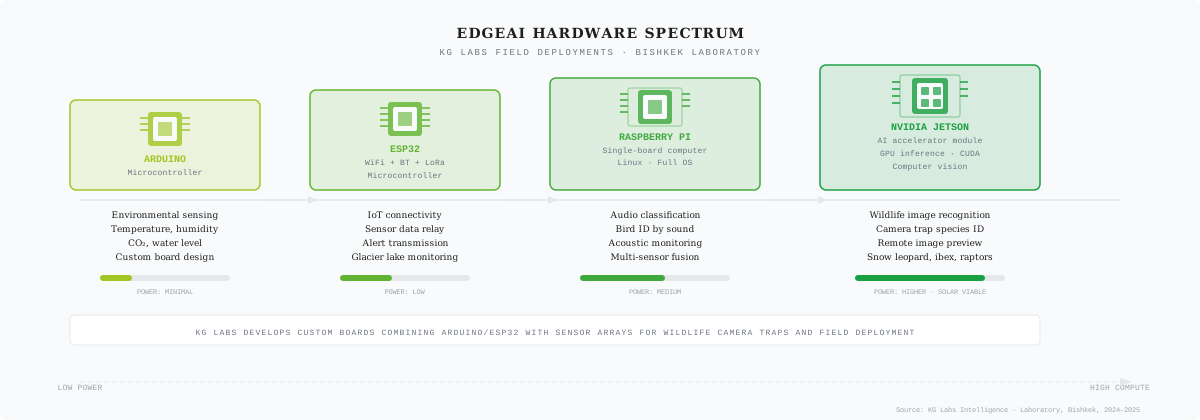
KG Labs is experimenting with custom-built boards for wildlife camera traps that apply the same edge principle: a local AI model identifies the species in frame at the point of capture, compresses a small image preview, and transmits it remotely without waiting for a ranger to extract the card. The ranger receives an alert with a preview — an animal identified, a location tagged, a time-stamped record — while still in the field. The full image archive stays on-device for later extraction, but the relevant signal travels immediately. This approach requires custom hardware design to keep the board small, low-power, and affordable enough to deploy across multiple sites simultaneously. That is the current stage of the work.
The stakes are higher at Zyndan.
Zyndan is a glacial lake in the Kyrgyz mountain range, at approximately 3,300 metres elevation. It sits roughly 20 kilometres from the communities that live at the base of the valley, at around 2,000 metres. That 20-kilometre distance involves a full day of hiking and more than 1,300 metres of vertical gain — not a route that can be checked regularly, and entirely impassable through the winter months. Zyndan has outburst-flooded twice in the last twenty years. Each event sent floodwater down toward those valley communities with little to no advance warning. The lake is still there. The risk profile has not changed.
This is what glacial lake outburst flood monitoring looks like in practice in Kyrgyzstan: a lake that has already demonstrated it can fail, located beyond practical human access for most of the year, monitored by traditional sensor networks that return data manually and process it in Bishkek. The time between an anomaly appearing and a decision being made can be days. In a flood event, the relevant window is hours.
EdgeAI deployed at the lake’s edge changes that relationship. Sensors measuring water level, temperature, vibration, and solar radiation via albedometer feed a local model running on a low-power device — an Arduino or ESP32 for lightweight sensing tasks, a Raspberry Pi for more general processing, or an NVIDIA Jetson where the inference load demands it. The model runs continuously, identifies deviations from baseline conditions, and pushes an alert over LoRa or satellite connectivity to emergency services and local community networks. No cloud required. No human presence required. The device operates on solar power, survives the winter, and monitors through the months when monitoring matters most.
The reason this approach hasn’t been deployed more widely is not the hardware — a Raspberry Pi is available at any electronics supplier, and the sensors needed for lake monitoring are standard environmental instruments. The gap is institutional and technical simultaneously. There is no nationwide AI computing infrastructure at ministry or agency level where more complex calculations could run. The scientists with the deepest domain knowledge work within institutions where frontier technology expertise is sparse; compensation structures in research and public science make it difficult to retain the people who develop those skills. The result is a persistent distance between what the science understands about these environments and what the technology can now do within them.
KG Labs has been closing that distance through practical work: laboratory testing of sensor and device configurations across the Arduino, ESP32, Raspberry Pi, and Jetson range; calibration of edge models against local environmental and acoustic data; and custom hardware development for specific field applications including camera traps. The partnerships that make this useful — with the ornithology community, with rangers and the administrations of biosphere reserves and wildlife protection zones, with glaciologists — are not peripheral to the technical work. They are the mechanism through which lab experiments become deployable systems. A model that identifies a Tian Shan snow leopard correctly in a laboratory test is not the same as one that identifies it reliably in a weatherproof housing at 2,800 metres in November. The field partners define what correct actually means.
The technology is not waiting to be invented. Zyndan’s next anomaly will not announce itself in advance. What changes the outcome is whether something is watching when the road is closed.
—
*Hardware and deployment references draw on KG Labs Intelligence, including laboratory work with IoT sensor systems and EdgeAI models at KG Labs’ Bishkek facility, 2024–2025.*
tags: [“EdgeAI”, “TinyML”, “IoT”, “climate monitoring”, “glacial lakes”, “bird monitoring”, “wildlife”, “camera traps”, “Kyrgyzstan”, “Sary-Chelek”, “Zyndan”, “disaster risk”]