
Climate · Mountain Partnership · FAO Rome
On International Mountain Day at FAO Rome, our work in the Pan-Third Pole was recognised in the Innovation category. The award is shared; the underlying problem — closed glacier data — is not solved.
2025-12-15 · Aziz Soltobaev · KG Labs Foundation
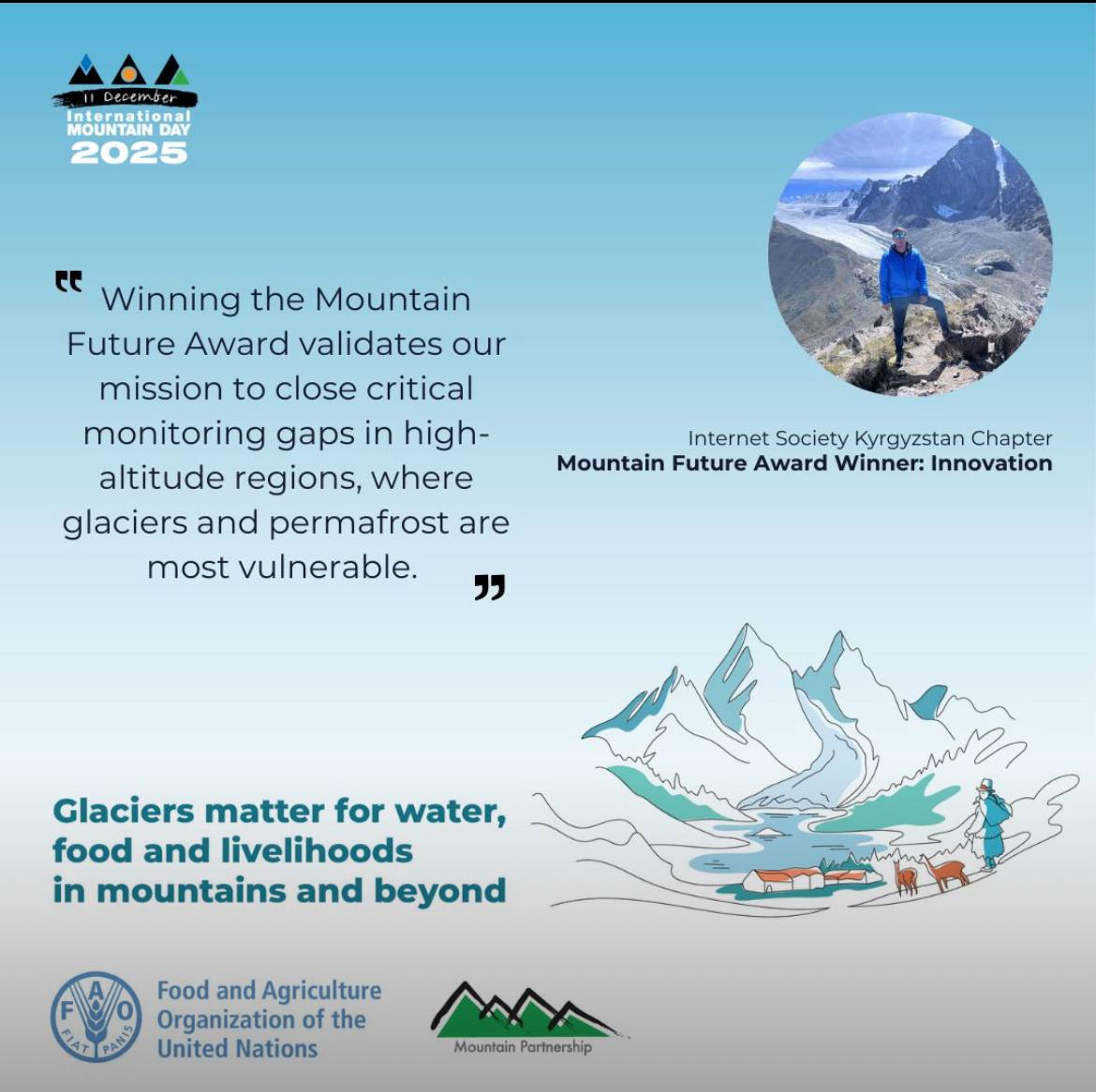
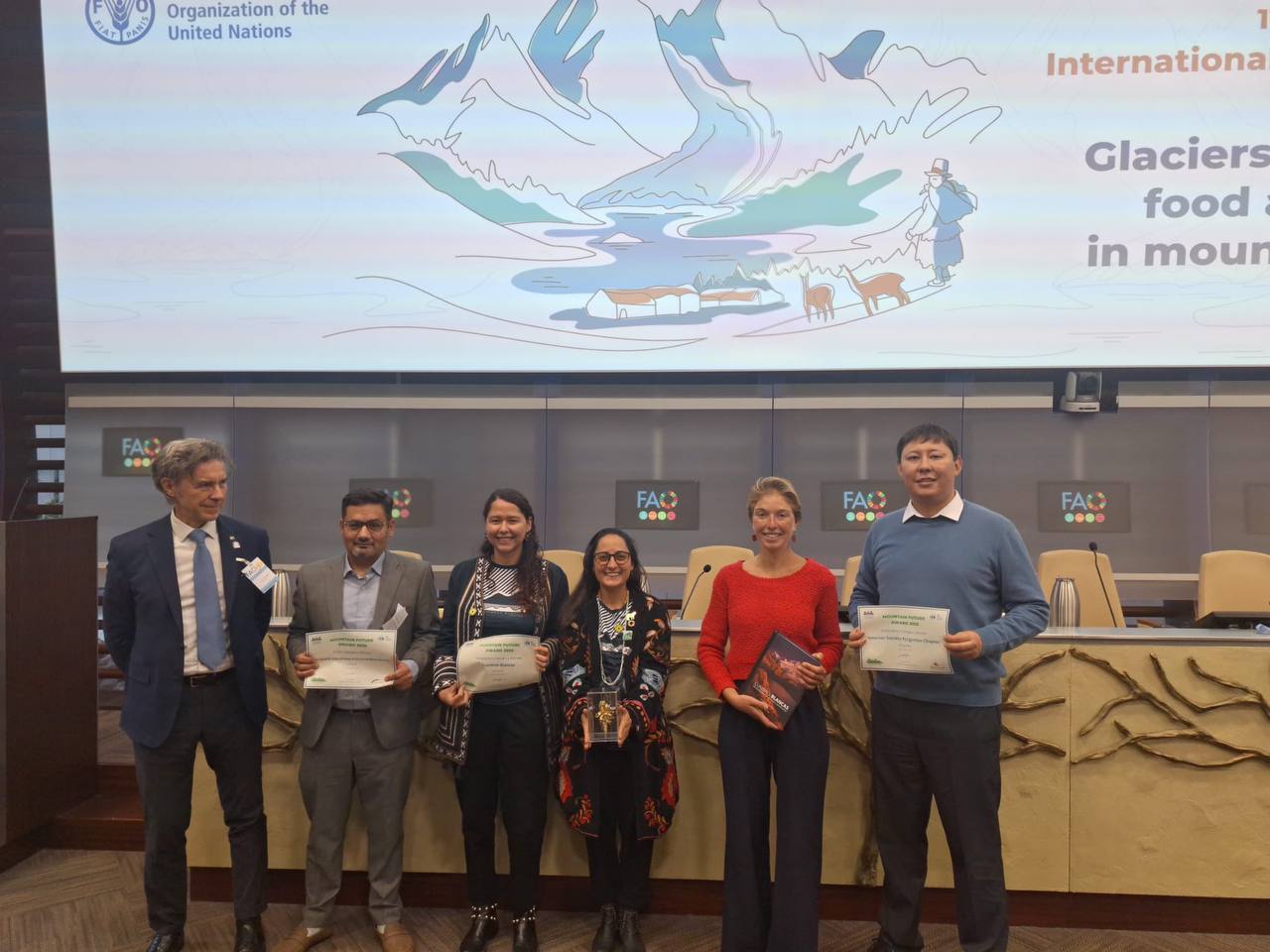
On 11 December 2025, at the head office of the Mountain Partnership inside the Food and Agriculture Organization of the United Nations in Rome, the climate-monitoring project I have been working on with the Internet Society Kyrgyz Chapter was named the winner of the Mountain Future Award 2025 in the Innovation category. The award was given for work on climate change and the preservation of glaciers in mountain regions, with International Mountain Day as the occasion.
I am writing this from inside the project, so let me be plain about whose work was recognised. The recognition belongs to the team in Kyrgyzstan that has been doing the field work — Azhybek Nurlanov, Murat, Maksat, Emil, Aleksandr, and Gulbar. The technical apprenticeship belongs to the radiocommunications group at the Abdus Salam International Centre for Theoretical Physics (ICTP) in Trieste, who have spent decades teaching low-cost wireless infrastructure for places that were not on the procurement maps of the larger meteorological services. The on-the-ground partnerships belong to the Ministry of Emergency Situations of the Kyrgyz Republic, the management of the Sary-Chelek Biosphere Reserve, and the management of the Karatal-Japyryk State Nature Reserve. The funding belongs to the Internet Society Foundation. My role on the day was to collect the award and represent the project; the work was the team’s.
The gap the award was given for
The Pan-Third Pole is the interconnected high-mountain system that runs from the Hindu Kush and Karakoram through the Pamirs and into the Tien Shan. Across that system, only about ten per cent of the meteorological stations sit above two thousand metres. Fewer than five per cent sit above three thousand. And yet it is above three thousand metres — in the zone of glaciers and permafrost — that the climate signal is most consequential and most under-observed.
From Kyrgyzstan specifically, before our work began, data from only two meteorological stations sitting above two thousand metres was available to the international scientific community. Two. For a country that is ninety per cent mountainous and that holds a meaningful share of Central Asia’s glacial water reserves, that is the order of magnitude we are starting from.
The work the award recognised is the demonstration that this gap is not a procurement problem and not a technology problem. The hardware to measure temperature, humidity, soil moisture, water level, and tilt at three thousand metres exists. The radio technology to bring those measurements back from places where no cellular signal reaches — LoRaWAN, paired with edge intelligence at the gateway — exists. The cost has come down by an order of magnitude in the last five years. What is missing is the institutional permission to use the new generation of instruments alongside the old, and the data architecture that lets the resulting measurements be used in real time by the people who need them.
We are showing, station by station, that the gap can be closed. Our dashboards at dashboard.isoc.kg now carry live measurements from sites including Chatyr-Kul, Son-Kol, the Ak-Sai valley, the Adygene glacier in Ala-Archa, the Kara-Batkak glacier in Issyk-Kul oblast, and the Sary-Chelek biosphere reserve, with separate views in Kyrgyz, Russian, and English. Local administrations and biosphere reserve managers see their own area’s data on dedicated dashboards. Updates flow every five minutes; the cost of cellular backhaul at each site is around seven hundred som a year.
The argument I made on stage
The argument I made when accepting the award — and the one I cared most about getting on the record — is that climate data should be treated as a Digital Public Good. Making it free, open, and machine-readable is the institutional change that decides whether the technical work scales beyond demonstration sites.
I will give a specific example of why this matters. To write a paper on the cryosphere in Kyrgyzstan that draws on the historical record, a researcher today has to pay Kyrgyzgidromet roughly three to five thousand US dollars for the underlying data. Three to five thousand dollars is not a tax on the largest research institutions in the world; it is a wall in front of every graduate student, every regional university group, every small NGO with a question worth asking. We know little about the glaciers that will melt in the next twenty-five to thirty years partly because the data describing them is closed, paid, and expensive.
That call — that countries should recognise climate data from their territory as a Digital Public Good, freely available, in service of mountain communities — was the part of the speech I wanted to land.
Context inside the Kyrgyz delegation
It mattered, on the day, that the Special Representative of the President of the Kyrgyz Republic for the Five-Year Action on Mountain Development, Dinara Kemelova, was one of the lead speakers opening the event. The Kyrgyz Republic’s work on the mountain agenda inside the Five-Year Action framework is taken seriously in the corridors at FAO; that is worth saying out loud because it sometimes is not visible from Bishkek.
The full ceremony — including the award procedure from the 57th minute — is on the FAO webcast: https://www.fao.org/webcast/detail/international-mountain-day-2025-high-level-event/en. Background on the award: https://www.fao.org/international-mountain-day/award/en/.
What the recognition does not change
The award is welcome, and it is shared. It does not yet move the closed data behind the paywall in Bishkek. It does not yet write the procurement guidance that would let the Ministry of Emergency Situations, the academy of sciences, and the Central Asian Institute for Applied Geosciences buy and deploy a second-tier station alongside a first-tier one. It does not yet train the next cohort of climatologists in Kyrgyzstan, of whom there are catastrophically few.
It does give us the institutional ground to keep arguing for those things. That is the part we will use it for.