

Climate · Pole of Cold · Naryn Oblast
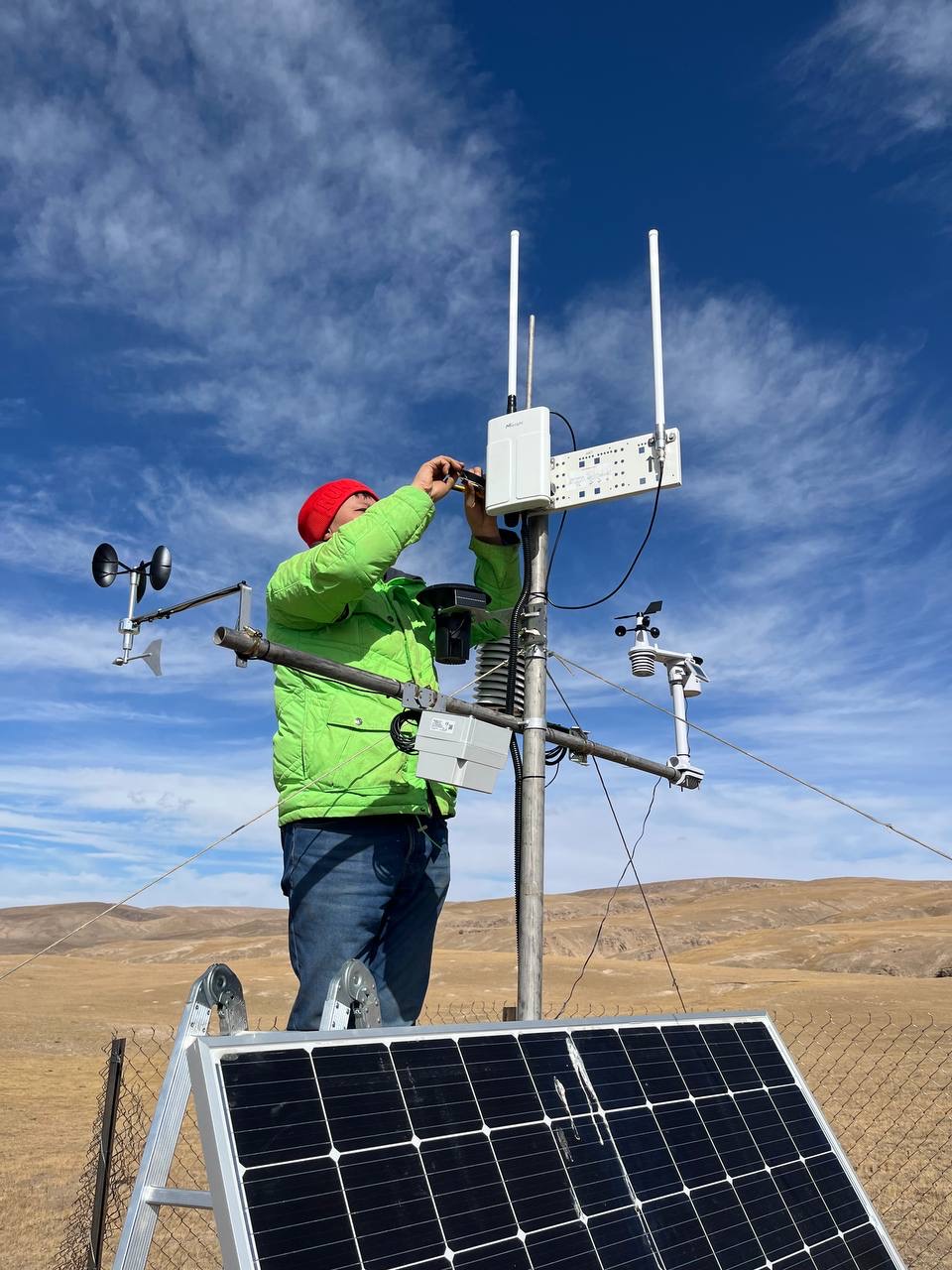
Six weeks after the first install, we returned to extend coverage and stress-test the equipment. At Chatyr-Kul, 3,613 metres, the temperature dropped to minus eight by sunset. The hardware kept transmitting; the local cellular provider did not.
2025-10-23 · Aziz Soltobaev · KG Labs Foundation
In Kyrgyzstan’s Ak-Sai valley, in Naryn oblast, temperatures have been recorded as low as minus forty-eight and a half degrees Celsius. That is the working benchmark. Will it be minus forty-eight again this winter? What is the weather right now at Sary-Chelek, Chatyr-Kul, Kel-Suu, or Son-Kol? What was it yesterday, a week ago, a year ago?
Those questions can now be answered in real time on our shared and site-specific dashboards: https://dashboard.isoc.kg/d/rum1F-uVz/meteodashbord?orgId=3&refresh=1d.
This post is the second-trip note. Six weeks after the September installation across the Karatal-Japyryk reserve, we have come back to extend coverage and to put the equipment through its first real cold-weather test. I want to record what happened.

What we extended
Under the climate-monitoring track of Internet Society Kyrgyz Chapter, we have been piloting and stress-testing modern communications kit and meteorological sensors at extreme altitudes — specifically in the permafrost zone — and at sites that matter for tracking the effect of climate change on biodiversity inside Kyrgyzstan.
A couple of weeks ago we successfully brought online new stations at:
- Chatyr-Kul — 3,613 metres
- Son-Kol — 3,016 metres
- Chatyr-Tash — 3,121 metres
We also corrected the configuration at the Sary-Chelek biosphere reserve station at 1,921 metres, which had needed a follow-up after the original install in July. These additions complement the picture from the Kara-Batkak glacier station and the glaciologists’ station at Chon-Kyzyl-Suu that we brought up earlier in the season.
What is new in this set of sites is the permafrost. The new locations — except Sary-Chelek — sit inside the permafrost zone, which has been the area least well covered by ground-based meteorological sensors not only in Kyrgyzstan, but across the Pan-Third Pole: Nepal, the north of India, Tibet, Myanmar, Bhutan, Tajikistan. With this set of installs, Kyrgyzstan can hold the widest ground-based observation grid in the region for how permafrost is changing.
What I want recorded about Chatyr-Kul
One of the new sites is the same Ak-Sai valley where the country’s lowest winter temperature, minus forty-eight, was registered. We chose it for that reason. Extreme conditions are the place where new generations of telemetry and communications kit either prove themselves or get sent back to the lab.
On the day we installed at Chatyr-Kul, at three thousand six hundred metres, we finished the install late into the evening. With the sunset the weather changed sharply: the air temperature dropped to minus eight, and a hard, cold wind came up. Hands and feet stopped responding. We stayed and finished the job.
The kit kept transmitting. The communications path stayed up. That is what we needed to know.


What KG Labs is layering on top
The communications and sensors are the foundation. Through KG Labs Public Foundation, we are also using the supercomputers we have access to in Bishkek to develop machine-learning and AI solutions that work on top of the ground-based observation stream. The aim is to track the effect of climate change on plant photosynthesis, to identify migratory birds passing through these sites, and to capture photo and video imagery of wildlife in real time, with the smallest possible energy footprint at the sensor end.
That is the part of the project that scales beyond cryosphere observation into broader biodiversity work. Once the data path is in, multiple sensor types can ride on it.
We are grateful to the management of the protected nature parks at Karatal-Japyryk and Sary-Chelek for the on-the-ground partnership and for facilitating every piece of the install. None of this is possible without them.
[VIDEO: short reel from the site]
A note on cellular coverage that has to be in writing
I have to record one thing that affects how this kind of project is going to scale in Kyrgyzstan. The operator MEGA — «Пользуйся нашей связью» — turned on cellular service at the Son-Kol lake on 12 August. Two months later, without any prior notice, the service was turned off again.
I am genuinely shaken by the unannounced disconnection. The wider problem is the tourists who chose to see Son-Kol in winter and arrived expecting cellular coverage to be there, because it had been advertised as there. There is also the contradiction with the government’s stated direction on developing year-round tourism. That contradiction is on the operator to resolve.
The narrow, practical request is that future disconnections of this kind be announced in advance through Kyrgyz media, so users — both ours, and tourists, and local residents — can plan around the gap. The network architecture of any climate-data project on Kyrgyz territory has to assume that this kind of provider behaviour is part of the operating environment, and our architecture now does.
Going up next month
Three more high-altitude locations above three thousand metres remain on the install list for October. We want to finish them before the year’s first real snowpack closes the routes. If we can get the next three in before the road windows close, the wider observation grid in the Pan-Third Pole will be in shape going into next year’s season.